Project Initiation
General System & Permissions
Release Notes
January 2026
May 2025
September 2024
June 2024
January 2024
December 2023
September 2023
August 2023
July 2023
June 2023
May 2023
Supplier Management How-To Guides
Supplier Admin & Information Management
Data Governance Dashboard
Supplier Creation
Onboarding Management Plans
Completing Activities
Assigning Classifications to a Supplier record
Issuing an External Assessment
Supplier Status
Supplier Onboarding Dashboard
Assigning Contacts & Stakeholders
Uploading Documents to a Supplier record
Suppliers Dashboard
Supplier Compliance Management
Assigning Insurances and Certifications
Insurances & Certifications Dashboard
Team Governance Dashboard
Assessment Summary Dashboard
Supplier Risk & Issue Management
Issuing a Risk Assessment
Risk Assessments Dashboard
Creating a Supplier Risk
Managing a Supplier Risk
Creating a Supplier Issue
Managing a Supplier Issue
Supplier Risk Management Dashboard
Supplier Relationship & Performance Management
Contract Management How-To Guides
Contract Admin & Information Management
Contract Creation
Assigning Classification(s) against a Contract record
Contract Health Drivers & Checklist Completion
Contract Setup Dashboard
Uploading Documents to a Contract record
Contracts Dashboard
Foreign Currency
Contract Milestone & Key Date Management
Contract Renewals Management
Sourcing Management How-To Guides
Creation and Planning
Sourcing Activity Creation
Planning Tab
If you are Planning with Quick Quotes
If you are Planning with Opportunities Hub
Completing the Planning Phase
At Market
If you are At Market with an external tool
If you are At Market with Quick Quotes
If you are At Market with Opportunities Hub
Completing the At Market Phase
Evaluation
Outcome
Procurement Act 2023
Procurement Act Introduction and Navigation
Transforming Public Procurement
Source- to-Contract and the Procurement Act
Source-to-Contract Procurement Act Prerequisites
Navigating Procurement Act Features Within Source-to-Contract
Overview of Procurement Act Notices
Procurement Act Deep Dive
Bolt Ons
Additional Help
Knowledge Deep Dive
Process Templates (Contracts)
Process - For System Users
Contract Stage Progression Process
Requesting Stage Approval
Approving Stage Approval Requests
Variation Process
Requesting Variation Approval
Approving Variation Approval Requests
Contract Process Comparison
Configuration - For System Administrators
Supplier Categories
Management Plans
Artefact Groups
Activities
Triggers and Schedules
Supplier Data Requests
Delegation of Authority - Configuration
Delegation of Authority - Process
Terminology & Configuration Guides
Frequently Asked Questions
Where can I find information on the Procurement Act features?
Why can't I apply a variation against my contract?
How do I filter within Analytics?
I cannot access certain areas of the system, why?
How do I switch email alerts on?
How do I 'Finalise' my contract?
How long does it take for Analytics to update?
What file types can I upload?
The OneAdvanced Customer Support Portal
Admin: How can I assign a User the 'Contract Manager' role on the Customer Support Portal?
How to raise a Support case?
Admin: How can I remove a User from the Customer Support Portal?
Customer Portal Guide
Admin: How can I grant Admin permissions to a User on the Customer Support Portal?
Admin: How can I find my organisation's Registration Code?
How do I access the OneAdvanced Customer Support Portal?
Admin: How do I approve a new User on the Customer Support Portal?
How can I raise a finance case with OneAdvanced?
- All categories
- Supplier Management How-To Guides
- Supplier Risk & Issue Management
- Risk Assessments Dashboard
Risk Assessments Dashboard

This dashboard provides an insight into the four Risk Assessments that are shipped with the out-of-the-box configuration. Each tab focuses on the responses provided to the different risk assessments.
Risk & Assurances
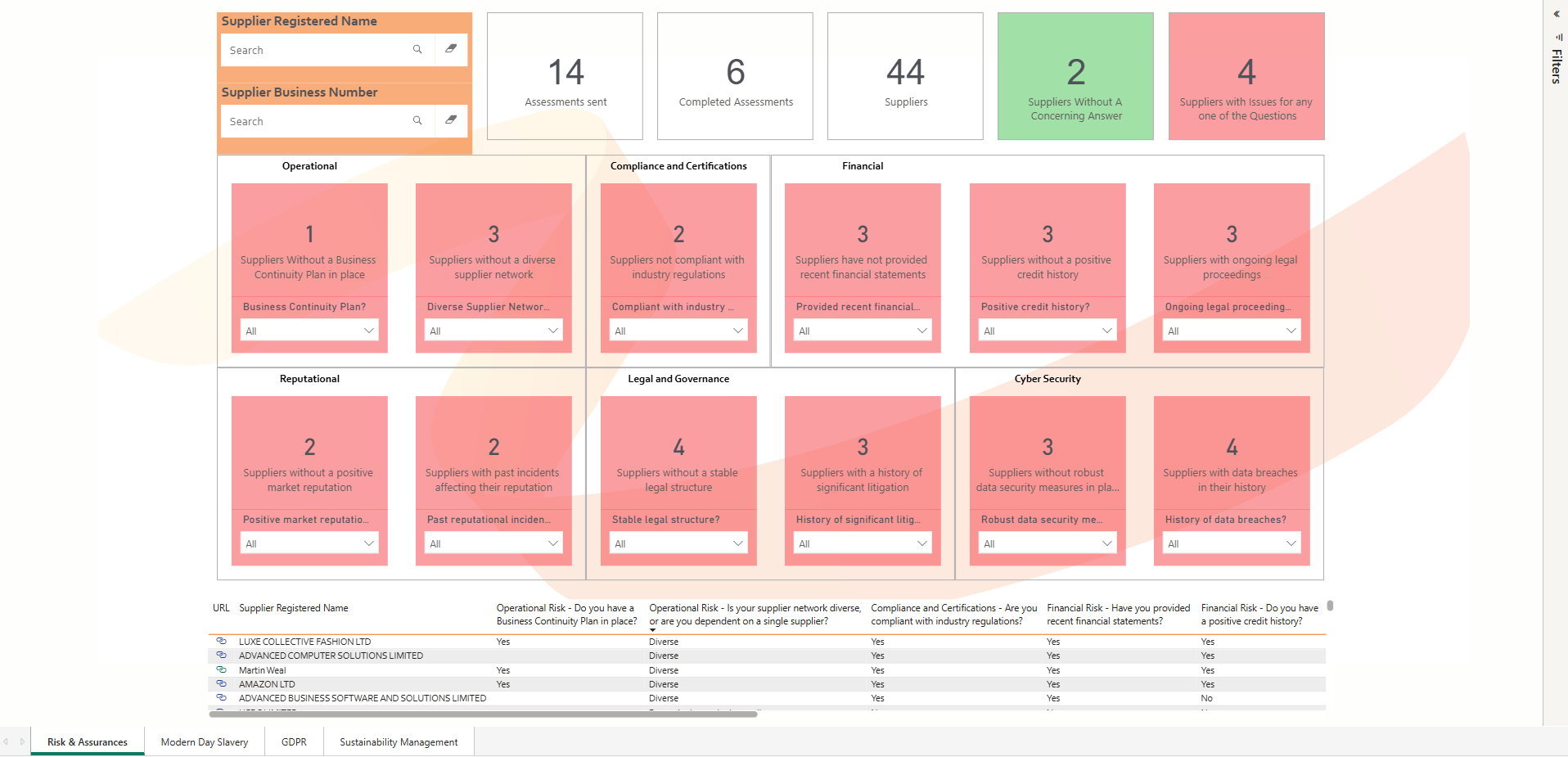
This tab is to assist users in reviewing responses to the preconfigured Supplier Risk & Assurance Information Request Form assessment.
This is unique among the risk assessments as it does not have a singular focus. Each question surrounds a specific risk that is separate from the others and might require closer attention.
As a result, each question is reported on individually in this dashboard. There are number tiles to reflect the responses to each question, showcasing the numbers of suppliers who have not answered the question with the preferred response, and accompanying filters. Similar to the Team Governance dashboard, the available values within these filters have been restricted so that the options that can be selected will only show the records that have a potential risk and need to be investigated further.
Once a risk has been identified, it should be added to the Risks & Issues section of the supplier record.
The two number tiles at the top right corner of the page provide a summary view of the risk level across your supplier base. The green tile displays the number of responses with no answers that pose a risk to your organisation, while the red tile shows the number of responses with at least one answer that may present a risk.
Modern Day Slavery
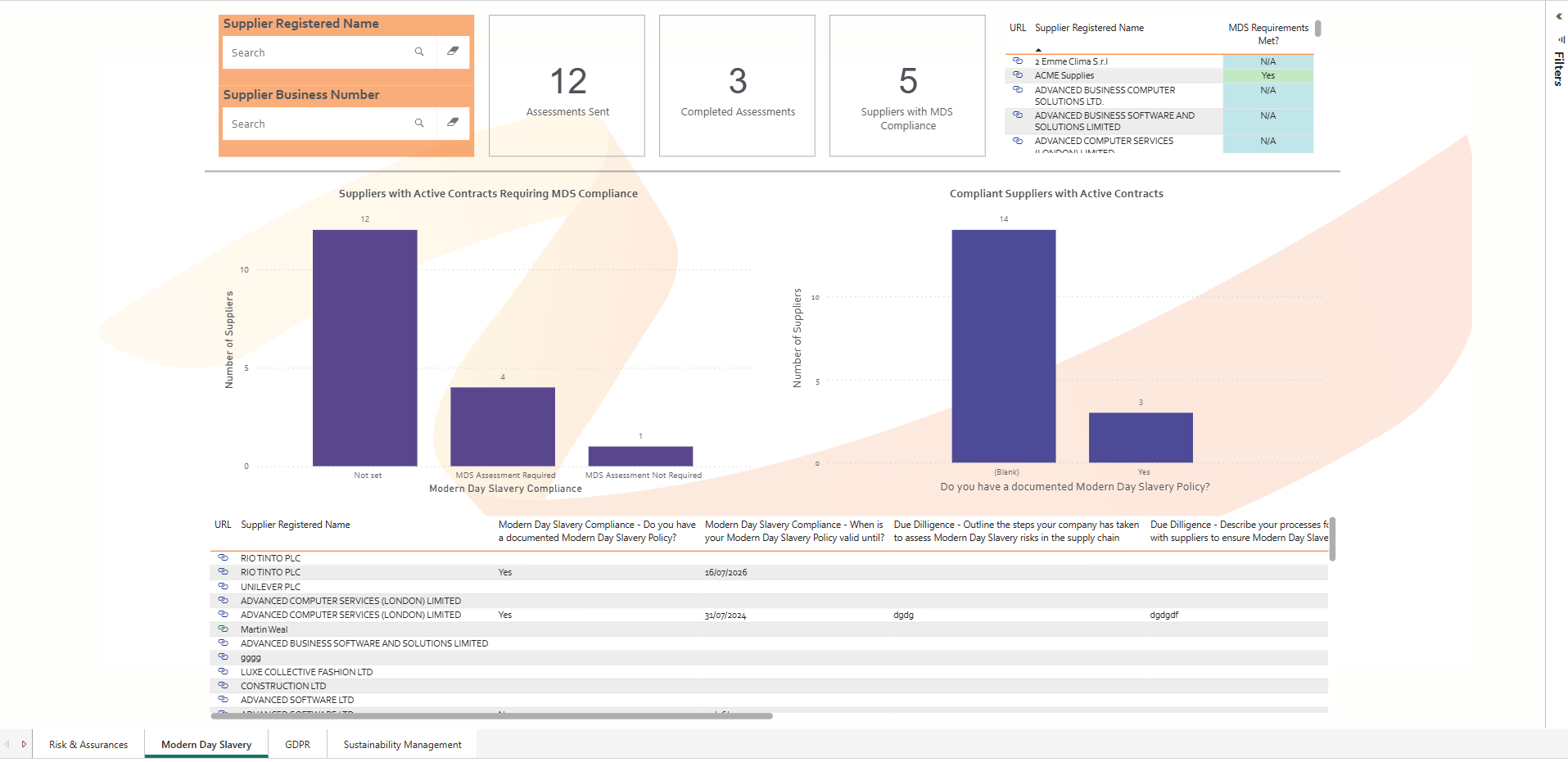
This tab is to assist users in reviewing responses to the preconfigured Modern Day Slavery Compliance Information Request Form assessment as well as the requirement for this compliance that has been stated.
The two visuals allow users to view the number of suppliers that have active contracts which require Modern Day Slavery Compliance, and the number of suppliers with active contracts that report to be compliant in their assessment response.
To further this compliance check, there is a table in the top right corner of the dashboard that highlights whether the MDS compliance requirements logged against a supplier’s contract record with classifications, are met by their assessment response.
Finally, individual question issues can be identified in the table below. Viewing all responses in a single table helps recognise trends and highlight common issues. This, in turn, can prompt reviews to determine additional steps for improving existing processes and preventing future issues.
If these questions highlight a risk for a supplier, that risk should be added to the Risks & Issues section of the supplier record.
GDPR
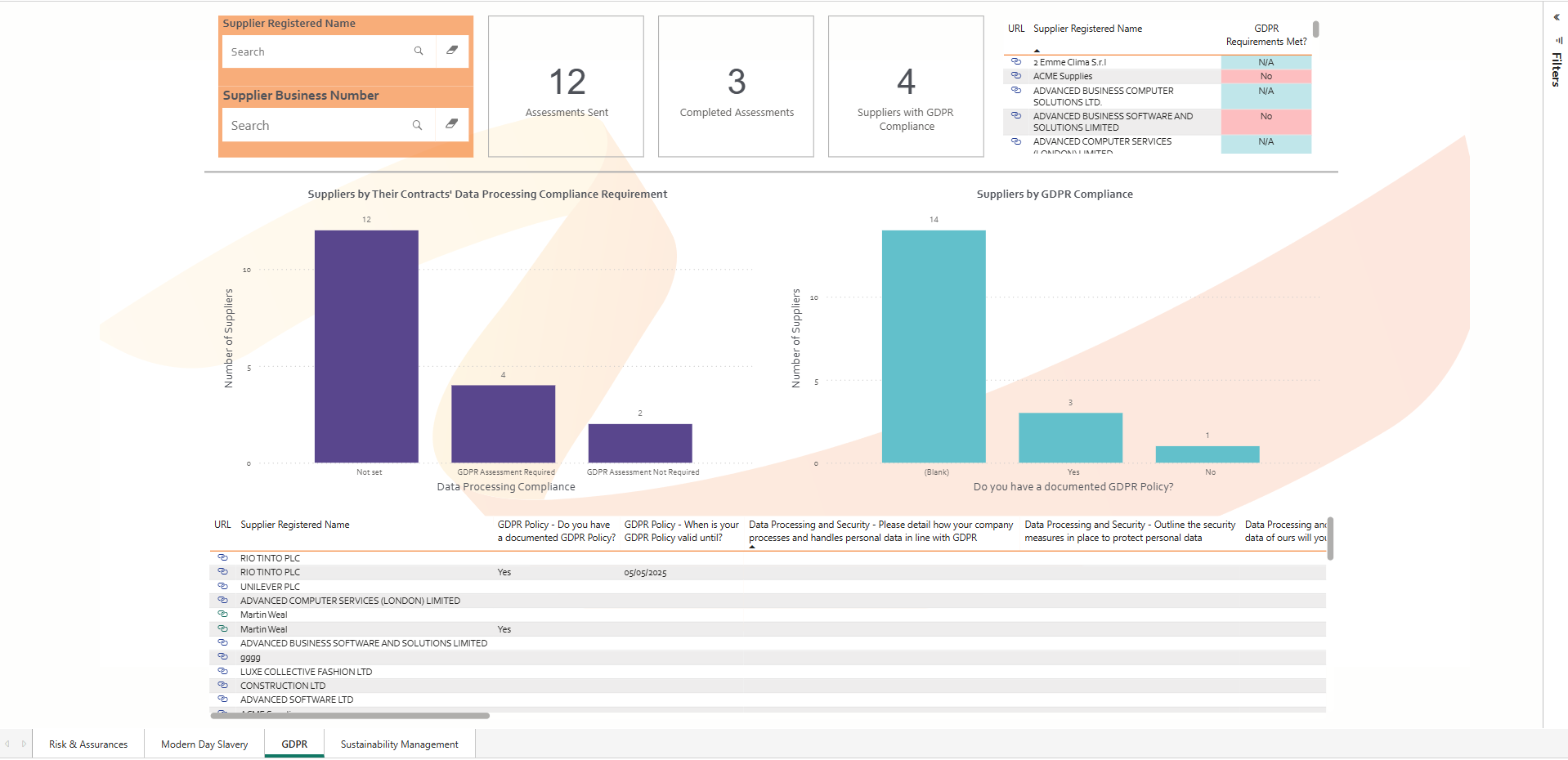
This tab is to assist users in reviewing responses to the preconfigured GDPR Compliance Information Request Form assessment as well as the requirement for this compliance that has been stated.
The two visuals allow users to view the number of suppliers that have active contracts which require GDPR Compliance, and the number of suppliers with active contracts that report to be compliant in their assessment response.
To further this compliance check, there is a table in the top right corner of the dashboard that showcases whether the GDPR compliance requirements logged against a supplier’s contract record with classifications, are met by their assessment response.
Finally, individual question issues can be identified in the table below. Viewing all responses in a single table helps recognise trends and highlight common issues. This, in turn, can prompt reviews to determine additional steps for improving existing processes and preventing future issues.
If these questions highlight a risk for a supplier, that risk should be added to the Risks & Issues section of the supplier record.
Sustainability Management
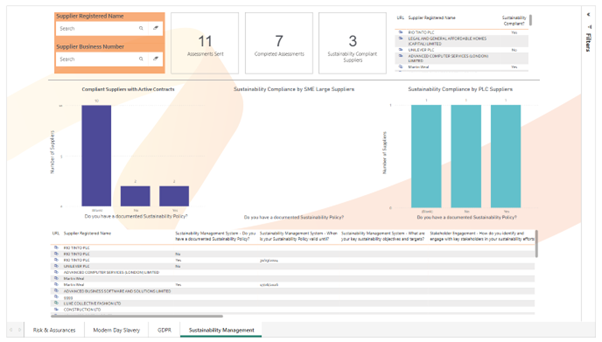
This tab is to assist users in reviewing responses to the preconfigured Sustainability & ESG Information Request Form assessment.
EU law requires all large companies and all public companies to disclose information regarding the impact of their activities on people and the environment. Therefore, the visuals that have been configured for this tab centre around these themes.
There is a visual simply for suppliers that are reporting to hold a sustainability policy, alongside compliant large suppliers and compliant PLC suppliers.
To try and align the layout of this tab with the previous two for ease of use, there is a small table in the top right corner of the dashboard that solely reports on whether the supplier is reporting to hold a sustainability policy.
Also, similarly to the previous two tabs, individual question issues can be identified in the table below. Viewing all responses in a single table helps recognise trends and highlight common issues. This, in turn, can prompt reviews to determine additional steps for improving existing processes and preventing future issues.
If these questions highlight a risk for a supplier, that risk should be added to the Risks & Issues section of the supplier record.