Project Initiation
General System & Permissions
Release Notes
January 2026
May 2025
September 2024
June 2024
January 2024
December 2023
September 2023
August 2023
July 2023
June 2023
May 2023
Supplier Management How-To Guides
Supplier Admin & Information Management
Data Governance Dashboard
Supplier Creation
Onboarding Management Plans
Completing Activities
Assigning Classifications to a Supplier record
Issuing an External Assessment
Supplier Status
Supplier Onboarding Dashboard
Assigning Contacts & Stakeholders
Uploading Documents to a Supplier record
Suppliers Dashboard
Supplier Compliance Management
Assigning Insurances and Certifications
Insurances & Certifications Dashboard
Team Governance Dashboard
Assessment Summary Dashboard
Supplier Risk & Issue Management
Issuing a Risk Assessment
Risk Assessments Dashboard
Creating a Supplier Risk
Managing a Supplier Risk
Creating a Supplier Issue
Managing a Supplier Issue
Supplier Risk Management Dashboard
Supplier Relationship & Performance Management
Contract Management How-To Guides
Contract Admin & Information Management
Contract Creation
Assigning Classification(s) against a Contract record
Contract Health Drivers & Checklist Completion
Contract Setup Dashboard
Uploading Documents to a Contract record
Contracts Dashboard
Foreign Currency
Contract Milestone & Key Date Management
Contract Renewals Management
Sourcing Management How-To Guides
Creation and Planning
Sourcing Activity Creation
Planning Tab
If you are Planning with Quick Quotes
If you are Planning with Opportunities Hub
Completing the Planning Phase
At Market
If you are At Market with an external tool
If you are At Market with Quick Quotes
If you are At Market with Opportunities Hub
Completing the At Market Phase
Evaluation
Outcome
Procurement Act 2023
Procurement Act Introduction and Navigation
Transforming Public Procurement
Source- to-Contract and the Procurement Act
Source-to-Contract Procurement Act Prerequisites
Navigating Procurement Act Features Within Source-to-Contract
Overview of Procurement Act Notices
Procurement Act Deep Dive
Bolt Ons
Additional Help
Knowledge Deep Dive
Process Templates (Contracts)
Process - For System Users
Contract Stage Progression Process
Requesting Stage Approval
Approving Stage Approval Requests
Variation Process
Requesting Variation Approval
Approving Variation Approval Requests
Contract Process Comparison
Configuration - For System Administrators
Supplier Categories
Management Plans
Artefact Groups
Activities
Triggers and Schedules
Supplier Data Requests
Delegation of Authority - Configuration
Delegation of Authority - Process
Terminology & Configuration Guides
Frequently Asked Questions
Where can I find information on the Procurement Act features?
Why can't I apply a variation against my contract?
How do I filter within Analytics?
I cannot access certain areas of the system, why?
How do I switch email alerts on?
How do I 'Finalise' my contract?
How long does it take for Analytics to update?
What file types can I upload?
The OneAdvanced Customer Support Portal
Admin: How can I assign a User the 'Contract Manager' role on the Customer Support Portal?
How to raise a Support case?
Admin: How can I remove a User from the Customer Support Portal?
Customer Portal Guide
Admin: How can I grant Admin permissions to a User on the Customer Support Portal?
Admin: How can I find my organisation's Registration Code?
How do I access the OneAdvanced Customer Support Portal?
Admin: How do I approve a new User on the Customer Support Portal?
How can I raise a finance case with OneAdvanced?
- All categories
- Additional Help
- Knowledge Deep Dive
- Process Templates (Contracts)
- Configuration - For System Administrators
- Creating a Process Template (Contracts)
Creating a Process Template (Contracts)

To create a new Process Template, click on Configuration and select the Process templates tab
From here, click on the +Process template button

Enter a Process template name and a Description, if required, and then click on Create
Once this has been done, you can further define the Process Template and enter the required details.
To align with the four possible Contract statuses, a Process Template includes four sections where you can define mandatory requirements for each status and the transitions between them.
The Process template is separated into Active Phases and Closure Phases.
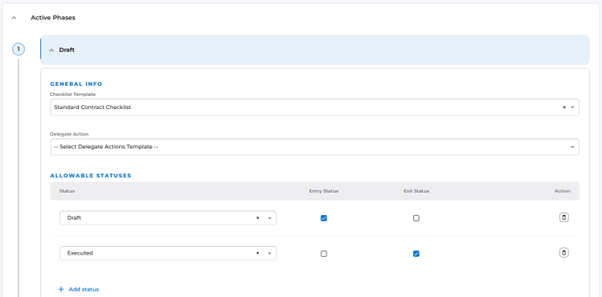
Active Phases
The Active Phases section allows the user to design the items required to move from the Draft phase to the Executed phase, and also specify any items that should happen during the Executed Phase.
By default, to progress through different phases a contract must have a Start Date, Value and Contract Type. When configuring a Process Template, you can also add a Checklist of items and/or a Delegate Action as additional steps that must be completed before the phase progression can be actioned. Before they can be added to the Process Template, the checklist items and Delegate actions need to be preconfigured in the corresponding sections of the Configuration module.
The tick boxes shown in the image above indicate the status the contract will move from and to once the actions have been completed. These should not need to be altered.
As alluded to above, the second step of the Active Phases does not progress the contract to a new stage, but will instead show that the actions required for an Executed contract have been completed.
Closure Phases
The Closure Phases section is laid out and configured in the same way as the Active Phases section and controls the move from Executed to either Completed or Terminated.
You can again add a Checklist of items and/or a Delegate Action as additional steps that need to be completed before the phase progression can be actioned, for example, an End of Contract Report.
Variation Process
Process Templates also determine the steps required for applying variations to a contract. By default, with our Standard Process Template, these require an Approval Delegate Action. Other Delegate Actions can be configured, but there is no option for a checklist at this stage.
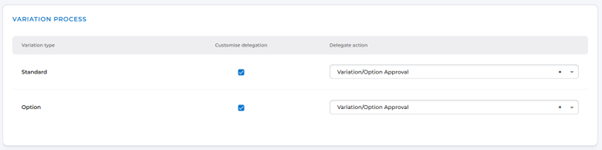
If the Customise Delegation box is unticked, no action is required and users could apply variations to contracts themselves at the point of creation.
In our out-of-the-box configuration, we have assumed customers will want more structure and governance around this process.