Project Initiation
General System & Permissions
Release Notes
January 2026
May 2025
September 2024
June 2024
January 2024
December 2023
September 2023
August 2023
July 2023
June 2023
May 2023
Supplier Management How-To Guides
Supplier Admin & Information Management
Data Governance Dashboard
Supplier Creation
Onboarding Management Plans
Completing Activities
Assigning Classifications to a Supplier record
Issuing an External Assessment
Supplier Status
Supplier Onboarding Dashboard
Assigning Contacts & Stakeholders
Uploading Documents to a Supplier record
Suppliers Dashboard
Supplier Compliance Management
Assigning Insurances and Certifications
Insurances & Certifications Dashboard
Team Governance Dashboard
Assessment Summary Dashboard
Supplier Risk & Issue Management
Issuing a Risk Assessment
Risk Assessments Dashboard
Creating a Supplier Risk
Managing a Supplier Risk
Creating a Supplier Issue
Managing a Supplier Issue
Supplier Risk Management Dashboard
Supplier Relationship & Performance Management
Contract Management How-To Guides
Contract Admin & Information Management
Contract Creation
Assigning Classification(s) against a Contract record
Contract Health Drivers & Checklist Completion
Contract Setup Dashboard
Uploading Documents to a Contract record
Contracts Dashboard
Foreign Currency
Contract Milestone & Key Date Management
Contract Renewals Management
Sourcing Management How-To Guides
Creation and Planning
Sourcing Activity Creation
Planning Tab
If you are Planning with Quick Quotes
If you are Planning with Opportunities Hub
Completing the Planning Phase
At Market
If you are At Market with an external tool
If you are At Market with Quick Quotes
If you are At Market with Opportunities Hub
Completing the At Market Phase
Evaluation
Outcome
Procurement Act 2023
Procurement Act Introduction and Navigation
Transforming Public Procurement
Source- to-Contract and the Procurement Act
Source-to-Contract Procurement Act Prerequisites
Navigating Procurement Act Features Within Source-to-Contract
Overview of Procurement Act Notices
Procurement Act Deep Dive
Bolt Ons
Additional Help
Knowledge Deep Dive
Process Templates (Contracts)
Process - For System Users
Contract Stage Progression Process
Requesting Stage Approval
Approving Stage Approval Requests
Variation Process
Requesting Variation Approval
Approving Variation Approval Requests
Contract Process Comparison
Configuration - For System Administrators
Supplier Categories
Management Plans
Artefact Groups
Activities
Triggers and Schedules
Supplier Data Requests
Delegation of Authority - Configuration
Delegation of Authority - Process
Terminology & Configuration Guides
Frequently Asked Questions
Where can I find information on the Procurement Act features?
Why can't I apply a variation against my contract?
How do I filter within Analytics?
I cannot access certain areas of the system, why?
How do I switch email alerts on?
How do I 'Finalise' my contract?
How long does it take for Analytics to update?
What file types can I upload?
The OneAdvanced Customer Support Portal
Admin: How can I assign a User the 'Contract Manager' role on the Customer Support Portal?
How to raise a Support case?
Admin: How can I remove a User from the Customer Support Portal?
Customer Portal Guide
Admin: How can I grant Admin permissions to a User on the Customer Support Portal?
Admin: How can I find my organisation's Registration Code?
How do I access the OneAdvanced Customer Support Portal?
Admin: How do I approve a new User on the Customer Support Portal?
How can I raise a finance case with OneAdvanced?
- All categories
- Additional Help
- Knowledge Deep Dive
- Delegation of Authority - Process
Delegation of Authority - Process

Delegation of Authority (DoA) is an important aspect of managing contracts and sourcing activities, ensuring that the right individuals are empowered to make decisions and take actions at the right time.
This process involves assigning specific responsibilities to users with the necessary roles, enabling them to approve or reject requests for actions within contracts and sourcing activities.
Actions can be required within contracts (And also Sourcing Activities) in different areas of the record, for different reasons, for example:
- Stage Approval
- Variation Approval
- Option Approval
These types of approval follow a consistent process, where a user requests an action to be completed by a user with the necessary role. The approver reviews the request and either approves or rejects it, ensuring that progression can occur. The key difference between these approval requests lies in the location within the system where approval is requested and the determination of the contract's value, which determines who should be assigned the approval task.
Requesting Actions with DoA
Stage approval is one example of an action necessary to move a contract from one stage to the next.
For example, a standard process template may require a procurement team member to approve the transition of a contract from the draft stage to the executed stage.
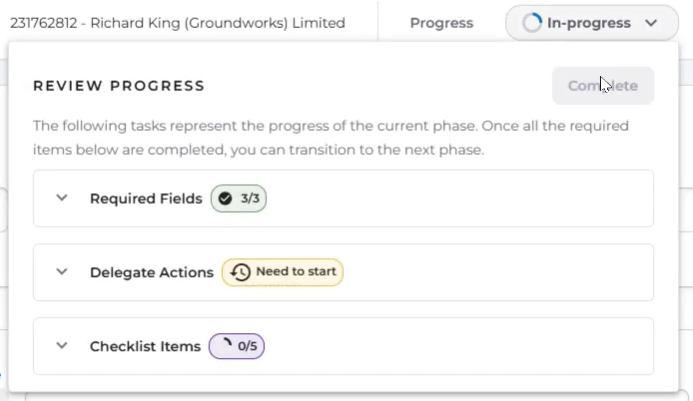
In this scenario, the In-progress dropdown of the contract's Process Template reveals that a Delegate Action is required to progress.
To complete this step, the user must first navigate to the Delegations tab of the contract / sourcing activity record:
Where the Delegations tab appears blank with no data fields available to populate.
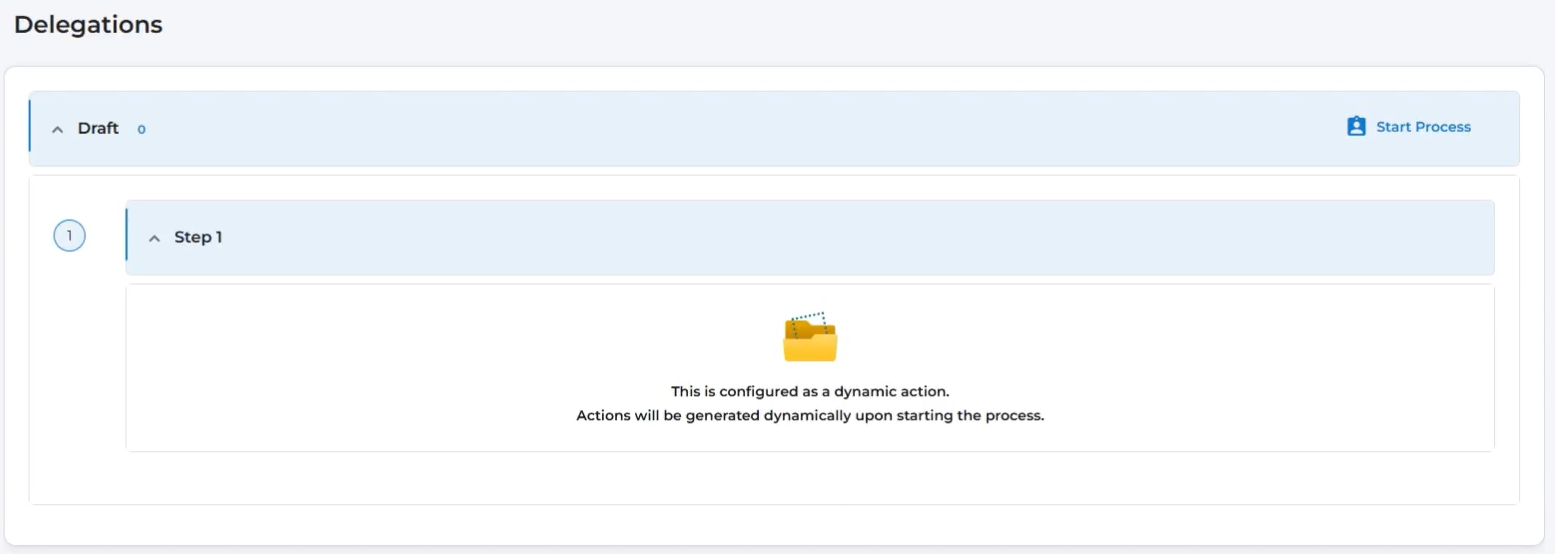
There are no fields available on arrival in this tab because Delegation of Authority is being utilised in this process template in place of the traditional Delegate Action template.
This is because the required action is dynamic, meaning the assignee will be determined by the contract record's value at the time the process is started, and is therefore subject to change.
When the user initiates the process by clicking "Start Process", the necessary fields to complete the request become available. At this point, the user can select the relevant approval level required for the specific contract/sourcing activity value.
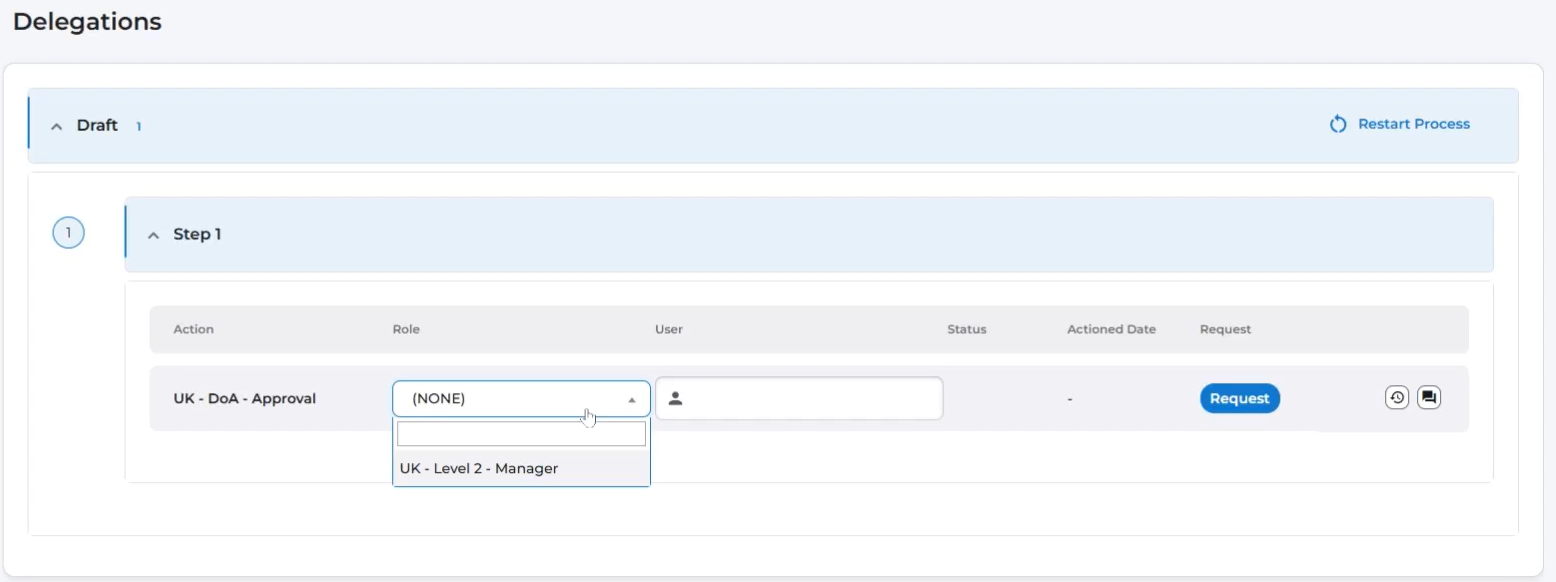
The approver for this progression is dynamically determined by the contract's current value. In this example, approval is currently required from a Level 2 Manager.
However, if the contract value were to change and fall within a different range, the required approval role would also change. For instance, if the contract value were to shift into a different level within the configured matrix, the approval could then be required from a Level 1 Line Manager.
This approach ensures that the approval process is determined by the value of the contract/sourcing activity, guaranteeing that the correct level of authority is involved in the decision-making process.
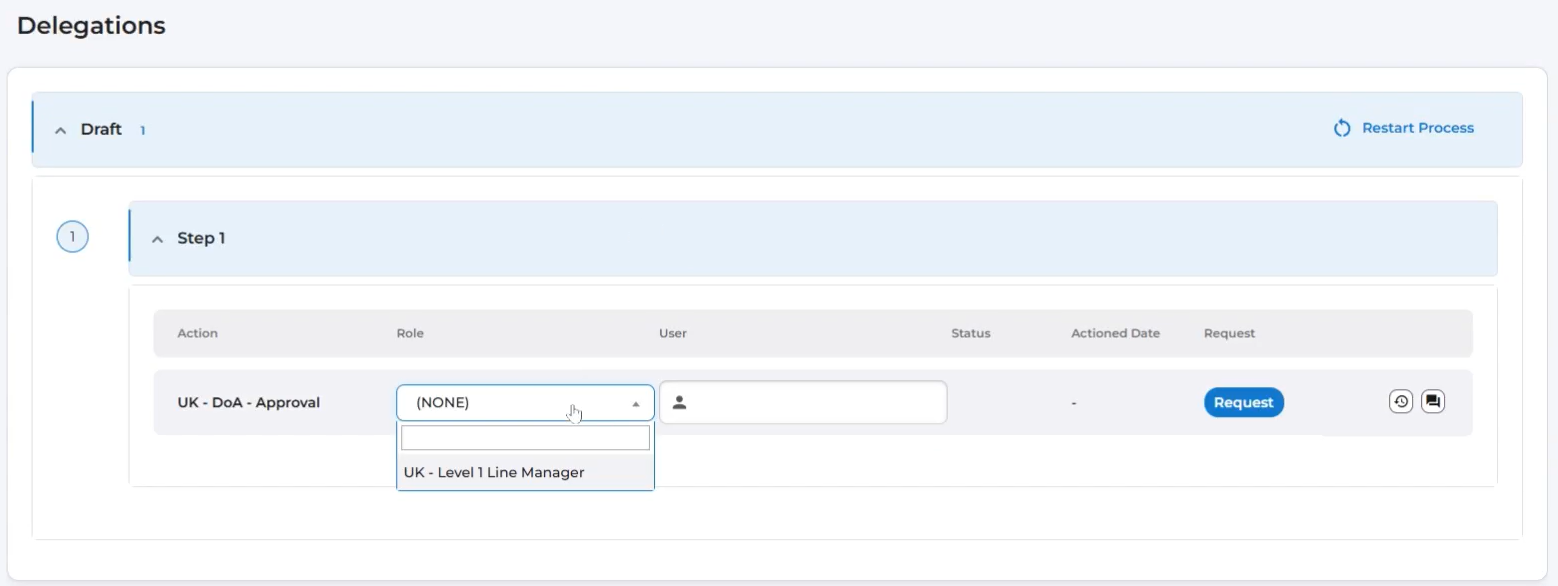
Once the role assignment is complete, the next step is to select the individual user who holds the required role. Once this has been chosen, the user can click the "Request" button to submit the approval request to the specified approver.
The approval process will then proceed as normal.
For a comprehensive understanding of the full process, including requesting and approving actions, please refer to the dedicated articles on Requesting Stage Approval and Approving Stage Approval Requests articles.
Additional Information
When applying the Delegation of Authority process to variations, including both standard variations and Options/Rights of Renewal, the current ex-tax value of the contract is combined with the proposed additional value to find the total value of the contract after the variation or extension has been applied. This combined value is then used to determine the necessary approval level.